
A “Misspelled” Name Story And The 100-Year Legacy of the Audemars Piguet “John Shaeffer”

The “Misspelled” Story and the 100-Year Legacy of the Audemars Piguet “John Shaeffer”
You may have come across, at some point, an Audemars Piguet watch with a cushion (tonneau) case, often associated with the name “John Schaeffer.”
Across major marketplaces like Chrono24, The 1916 Company, and even leading auction houses such as Christie’s, Sotheby’s, Phillips, and Antiquorum, the name “John Schaeffer” is widely used. Even Google seems to reinforce that spelling.
For a long time, I wasn’t entirely sure whether “John Schaeffer” or “John Shaeffer” was correct — until I came across a detailed article by Mark Kauzlarich on Hodinkee.
Source: Photo by Ben Clymer - Hodinkee
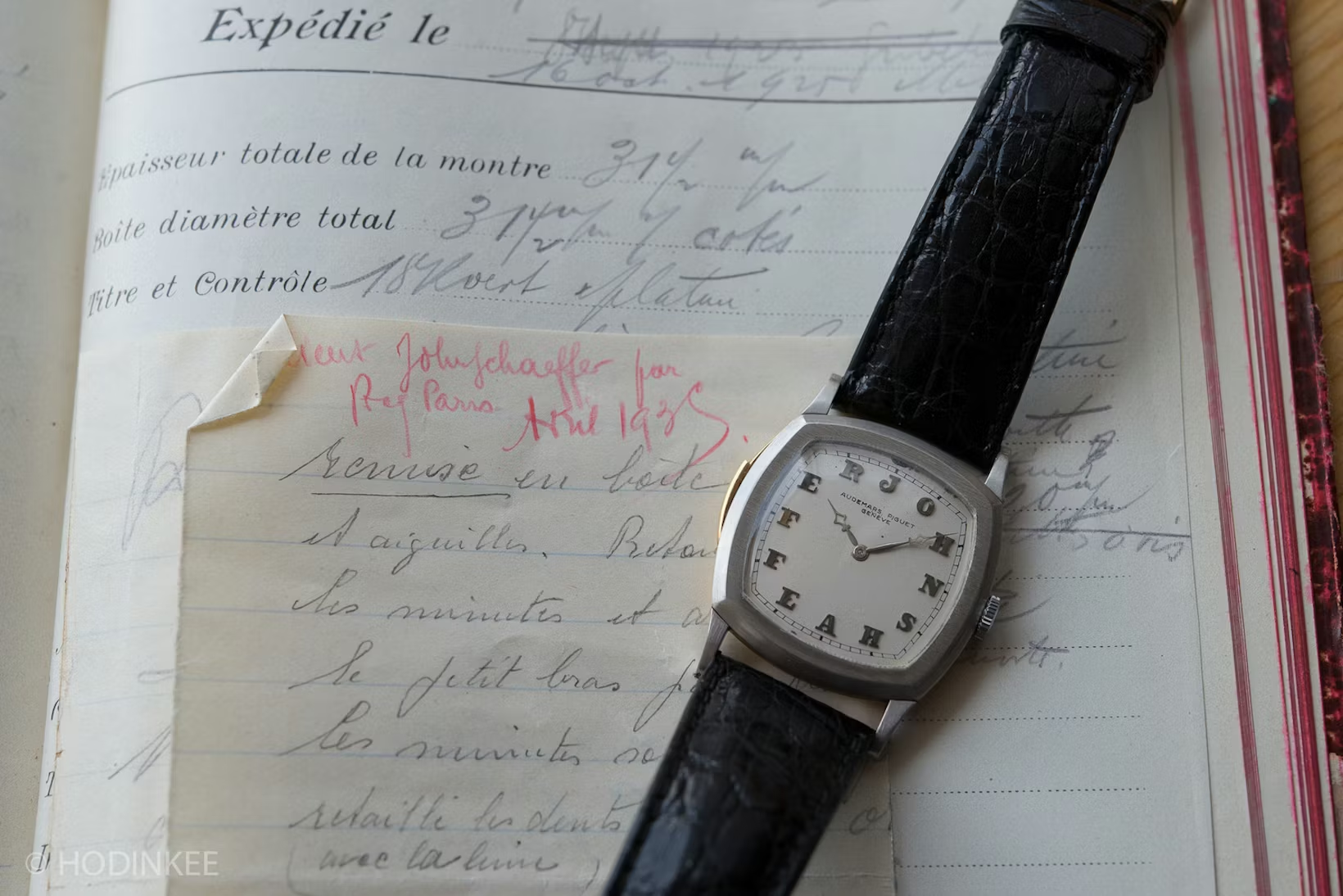
The watch is in fact the Audemars Piguet John Shaeffer — without the “C.” A small, softly squared watch, defined by a name consisting of exactly 12 letters. And those 12 letters are far from arbitrary.
The story begins in 1907, when Audemars Piguet started producing a minute repeater movement based on an ébauche from L.E. Piguet (cal. 12SMV), pushing the technical limits of the time. This was an era when a small repeater movement could cost more than a grand complication pocket watch — a clear indication of its complexity.
By 1908, the watch was completed and recorded under the account of Guignard & Co, before being sold through Asprey in London — a prestigious retailer serving Europe’s elite. The process followed the standard flow of the time: manufacture → retailer → client. Yet, what makes this watch different is that it did not stop there.
In 1915, Audemars Piguet took the watch back, restored it, and returned it to stock. In 1923, the movement was revised again, this time at the request of Gübelin — one of the most influential Swiss retailers, often acting as both distributor and technical collaborator for high-end timepieces.
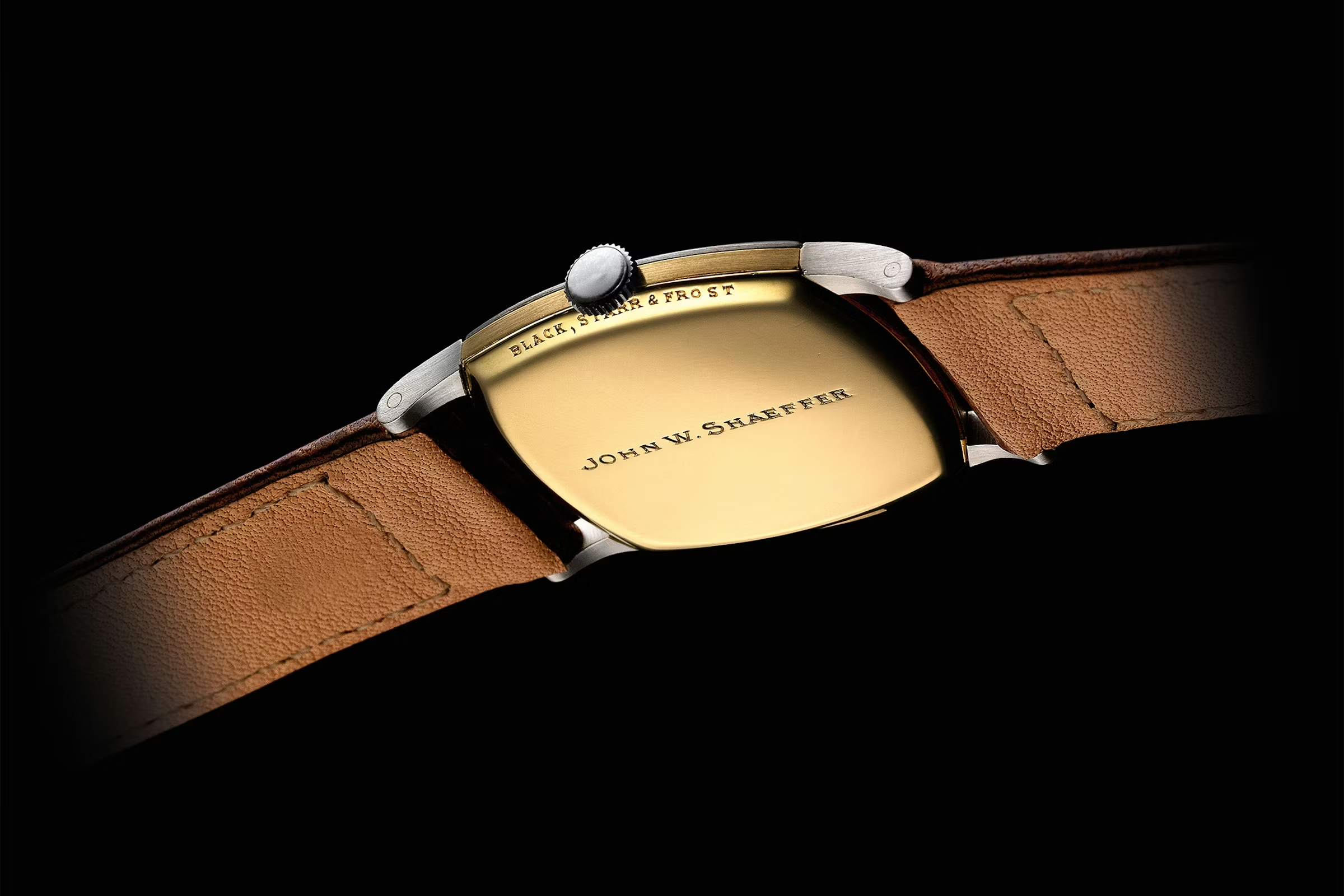
By 1925, the watch had made its way to the United States through the Metric Watch Company, and later appeared at Black, Starr & Frost — one of New York’s oldest and most prestigious jewelers.
Source: Photo courtesy Audemars Piguet.
Looking at this journey as a whole, one thing becomes clear:
The watch had passed through nearly the entire luxury watch ecosystem of the early 20th century — yet it still didn’t truly belong to anyone.
That changed in 1927, when John Wallace Shaeffer entered the story. As Vice Chairman of Allied Chemical & Dye Corporation, he was a prominent American industrialist. But what makes him significant here is not his status, but his perspective.
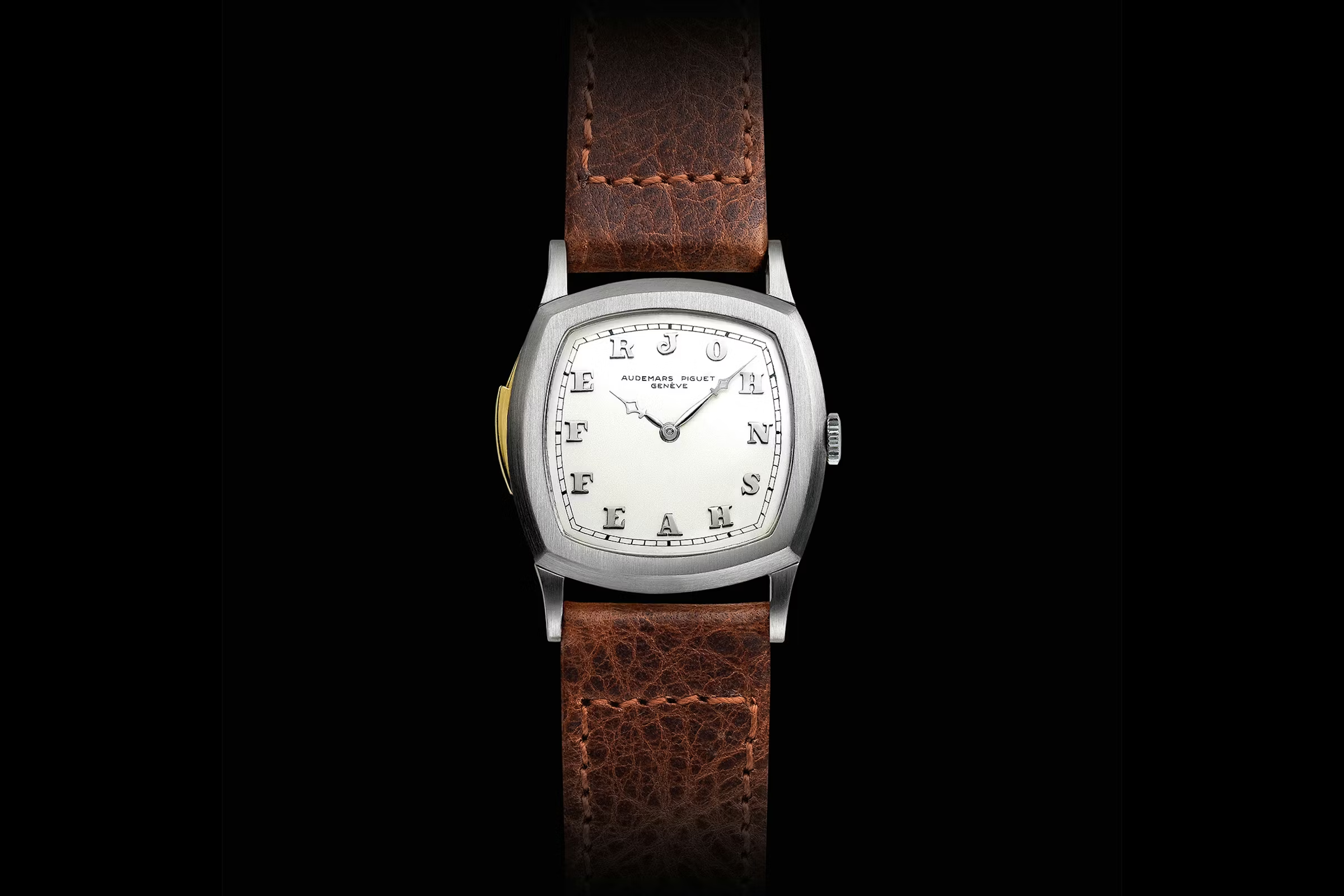
Instead of simply owning the watch, he sent it back to Audemars Piguet with a very specific request: to remake the dial, replacing all hour markers with his name — 12 letters corresponding to the 12 hour positions: J-O-H-N S-H-A-E-F-F-E-R.
Source: Photo courtesy Audemars Piguet.
This was not merely decorative customization. In the early 20th century, such personalized dials — sometimes referred to as “runic dials” — were not uncommon, particularly in the American market. But Shaeffer’s case was different.
Because this watch had already existed for nearly 20 years before it had a name.
It was not originally made for him — but he was the one who gave it an identity.
More than 60 years later, in the late 1980s, Audemars Piguet found inspiration in this very watch.
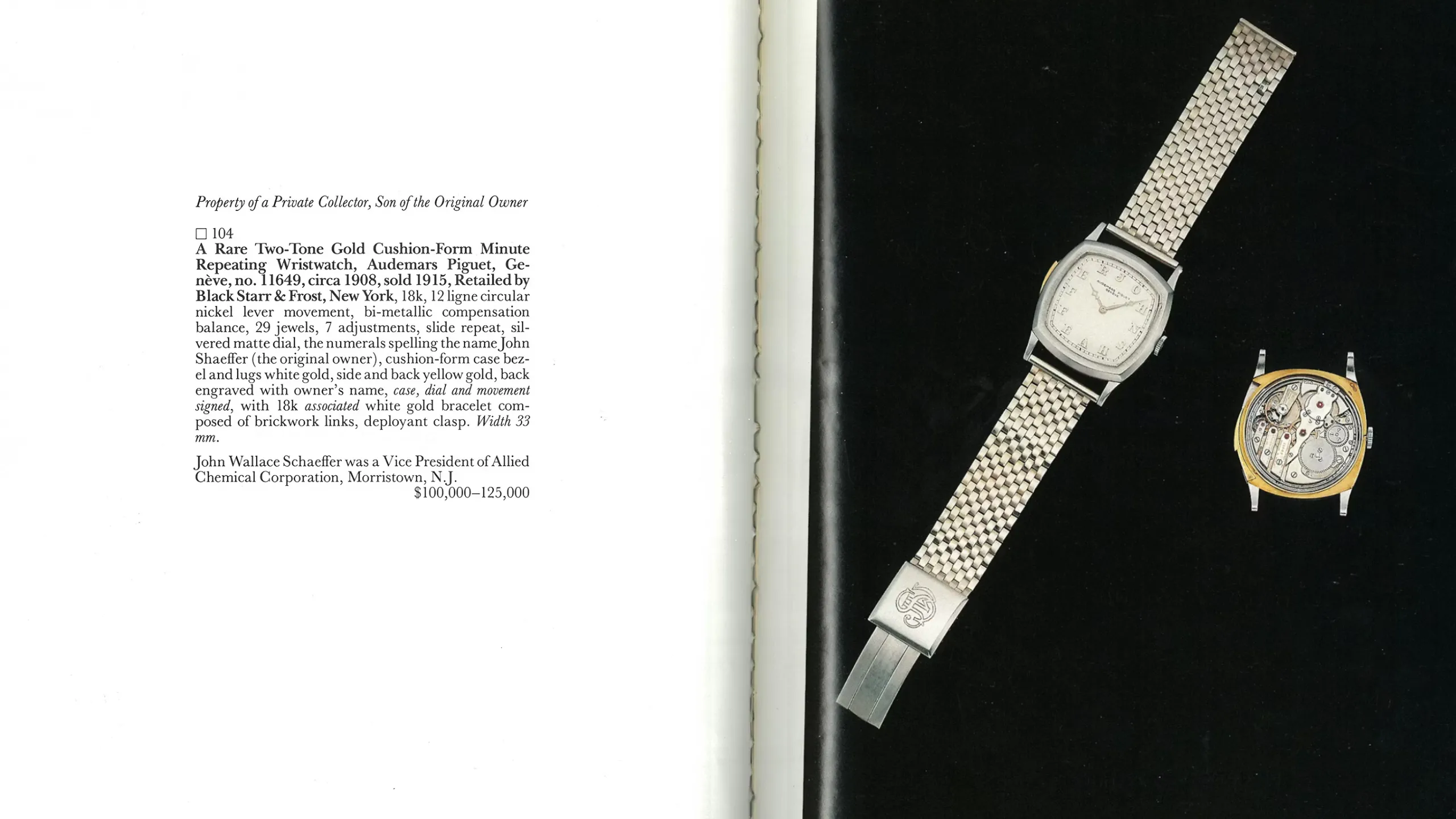
At Sotheby’s New York auction in October 1989, a cushion-shaped minute repeater associated with Shaeffer was offered with the description:
“A Rare Two-Tone Gold Cushion-Form Minute Repeating Wristwatch, Audemars Piguet, Genève, no. 11643, Circa 1908, Sold 1915, Retailed by Black, Starr & Frost, New York.”
Source: Photo courtesy Sotheby's.
Consigned by Shaeffer’s son, it carried an estimate of $100,000–125,000.
The final price reached approximately $220,000. The initial buyer was not Audemars Piguet — but the brand acquired the watch shortly afterward.
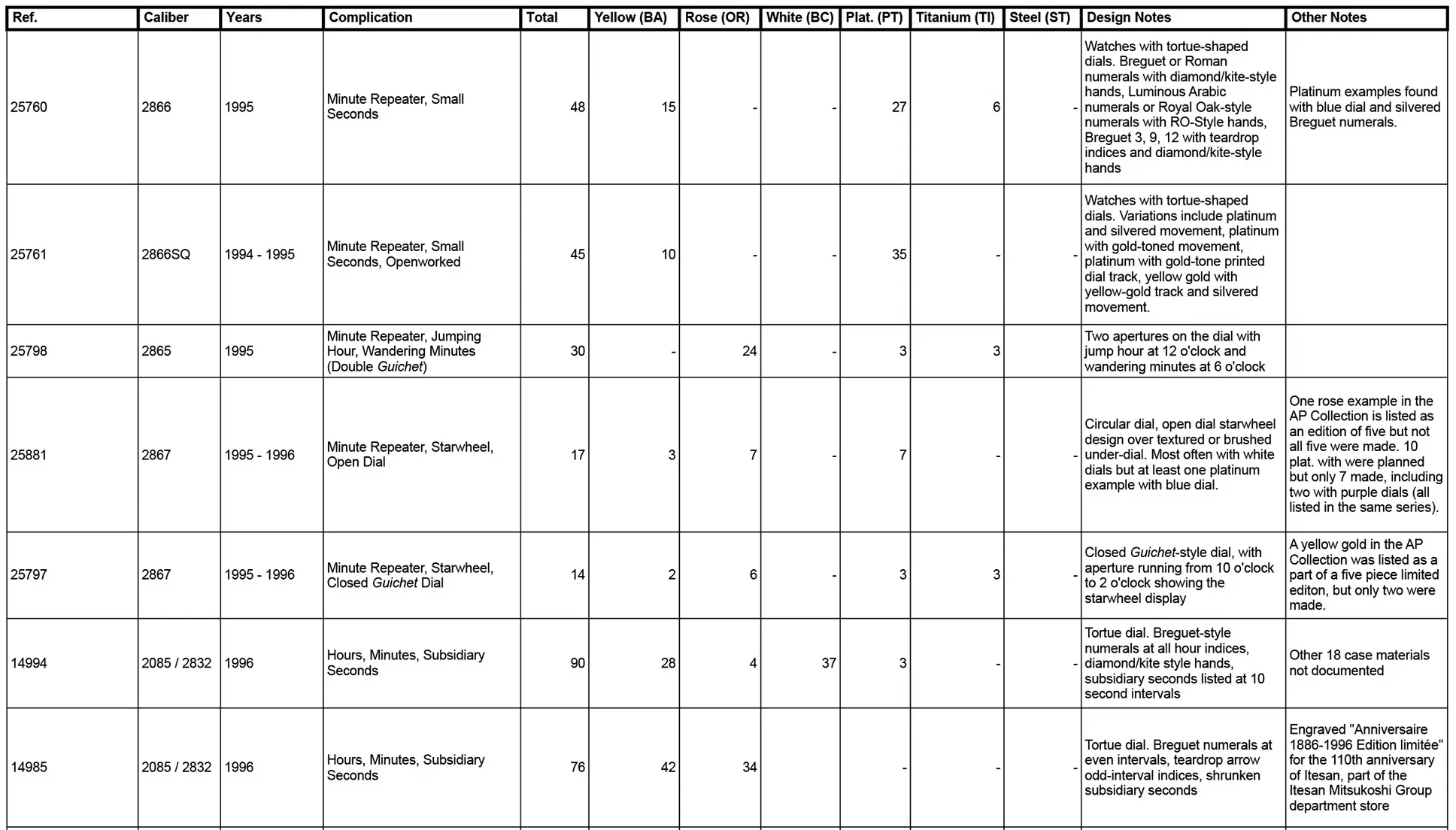
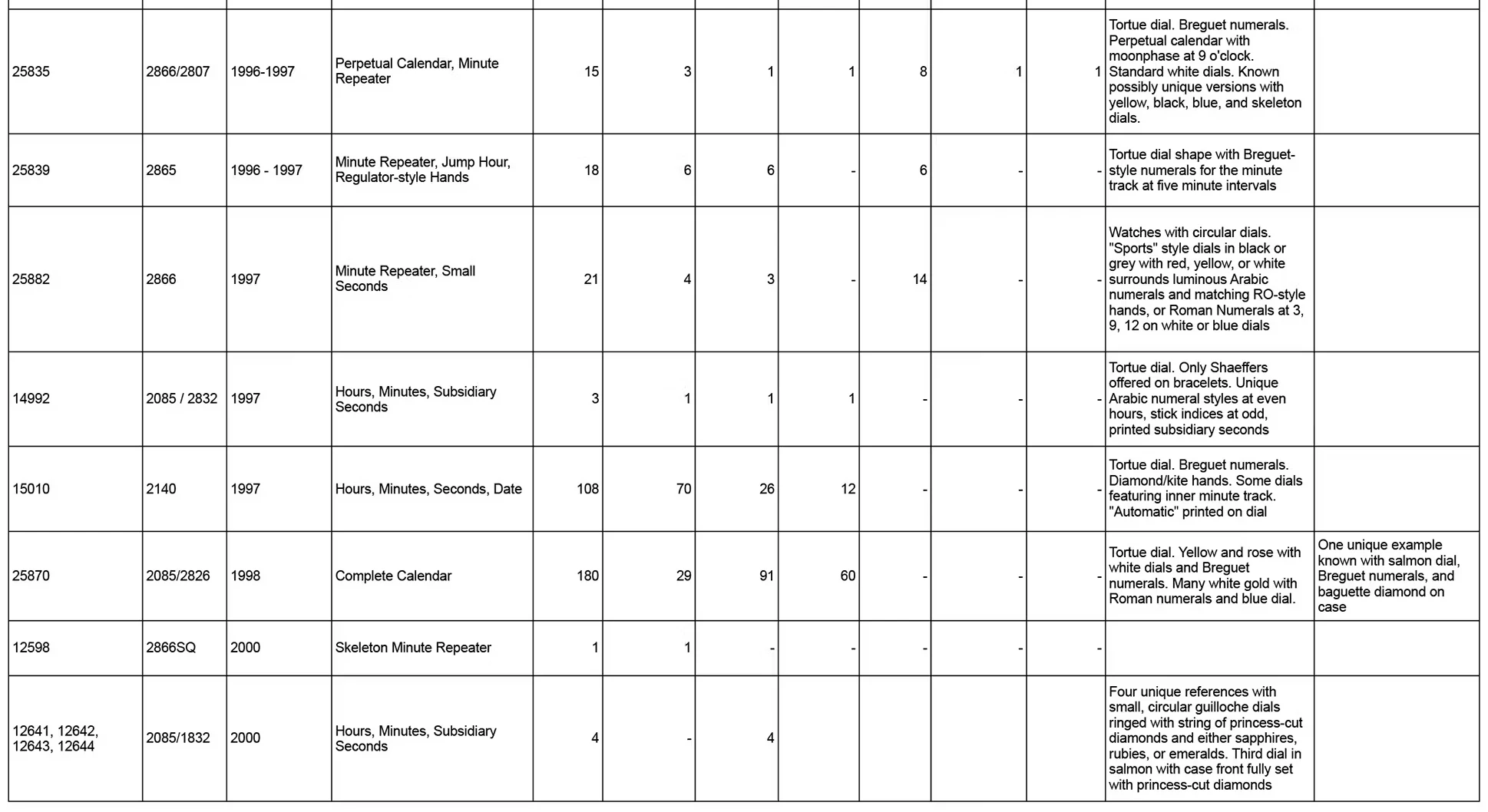
From 1995 to 1997, Audemars Piguet introduced a collection named John Shaeffer, with a total production of around 670 pieces. Among them were 209 minute repeaters — making the Shaeffer repeaters rarer than the Patek Philippe ref. 1518.
Source: Photo courtesy Hodinkee
Nearly half were cased in platinum, despite it being a suboptimal material for sound transmission. Thirteen examples were made in titanium — an exceptionally early and uncommon choice for the 1990s. Only one piece in steel and one in white gold have ever been recorded, and neither has surfaced publicly.
The collection spanned a wide range of configurations: time-only, jump hour, starwheel, perpetual calendar, and minute repeater. Yet they all shared a common DNA — the cushion-shaped case, compact proportions around 33–33.5mm, and a design language that felt slightly out of time: neither fully vintage nor entirely modern.
Perhaps this is precisely why the collection was not a commercial success, lasting only a little over two years.
But that does not diminish its value. On the contrary, it reveals something essential:
This was one of the rare moments when Audemars Piguet created something not for the market — but for itself. A project shaped over decades, through multiple revisions, reinterpretations, and refinements.
Audemars Piguet itself acknowledges this as one of the most significant timepieces in its heritage.
Today, watches from the John Shaeffer collection are increasingly sought after by seasoned collectors. Not because they were a failure — but because they were simply born at the wrong time.
More details about AP John Shaeffer 14994BA: Audemars Piguet John Shaeffer 14994BA 18k Yellow Gold - Men's watch | The Quintime
Source: Blog from Mark Kauzlarich - Hodinkee


