
Review Breguet Tradition Seconde Rétrograde 7097 Blue Ref. 7097BB/GY/9WU

A blue guilloché-engraved dial crowns a timepiece that pays tribute to the past, yet runs on a thoroughly modern automatic movement.
The Automatique Seconde Rétrograde, like all watches in the Tradition collection, draws inspiration from Breguet’s historic “subscription” timepieces. With most of the key components of a classical movement brought to the dial side, this Ref. 7097 features a new “Breguet blue” guilloché dial introduced in 2020, available exclusively through Breguet boutiques.
“Subscription” watches for the many
Breguet was not only a mechanical virtuoso, but also a remarkably shrewd entrepreneur. In 1796, he introduced the concept of the “subscription” watch, an early form of serial production sustained by what we might now call crowdfunding.
The idea was simple: prospective clients would place a deposit, a “souscription”, to finance the making of a relatively straightforward pocket watch, featuring a large diameter, a single hand, a simplified movement, and an accessible price. This model allowed Breguet to secure capital for components and establish a system to produce batches of similar watches.
The beauty of these subscription watches lay in the purity of their movement architecture, a principle Breguet would later carry into his earliest “tact” watches from 1799.
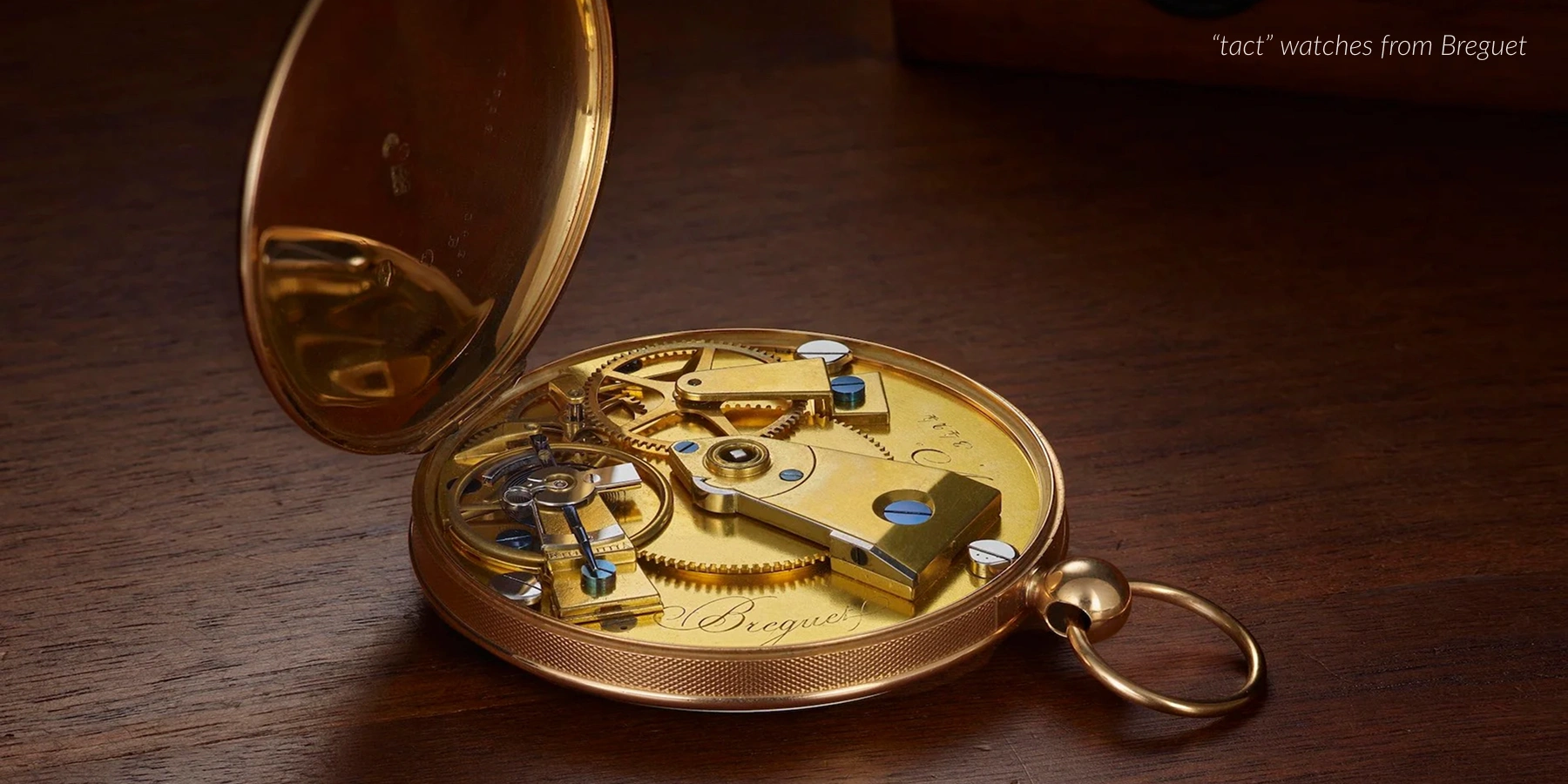
When the brand introduced the Tradition collection in 2005, the goal was to showcase elements of the original movement architecture that, in Breguet’s historical subscription watches, would have been hidden beneath the dial. However, rather than revealing them on the caseback, the bridges, gears, escapement, and mainspring barrel were brought to the top plate and displayed dial-side.
The Tradition 7097, introduced in 2015, added a rétrograde seconds complication to the lineup. Combined with the oscillation of the balance wheel, this rétrograde display brings a vivid sense of motion to the dial.
Balance and symmetry
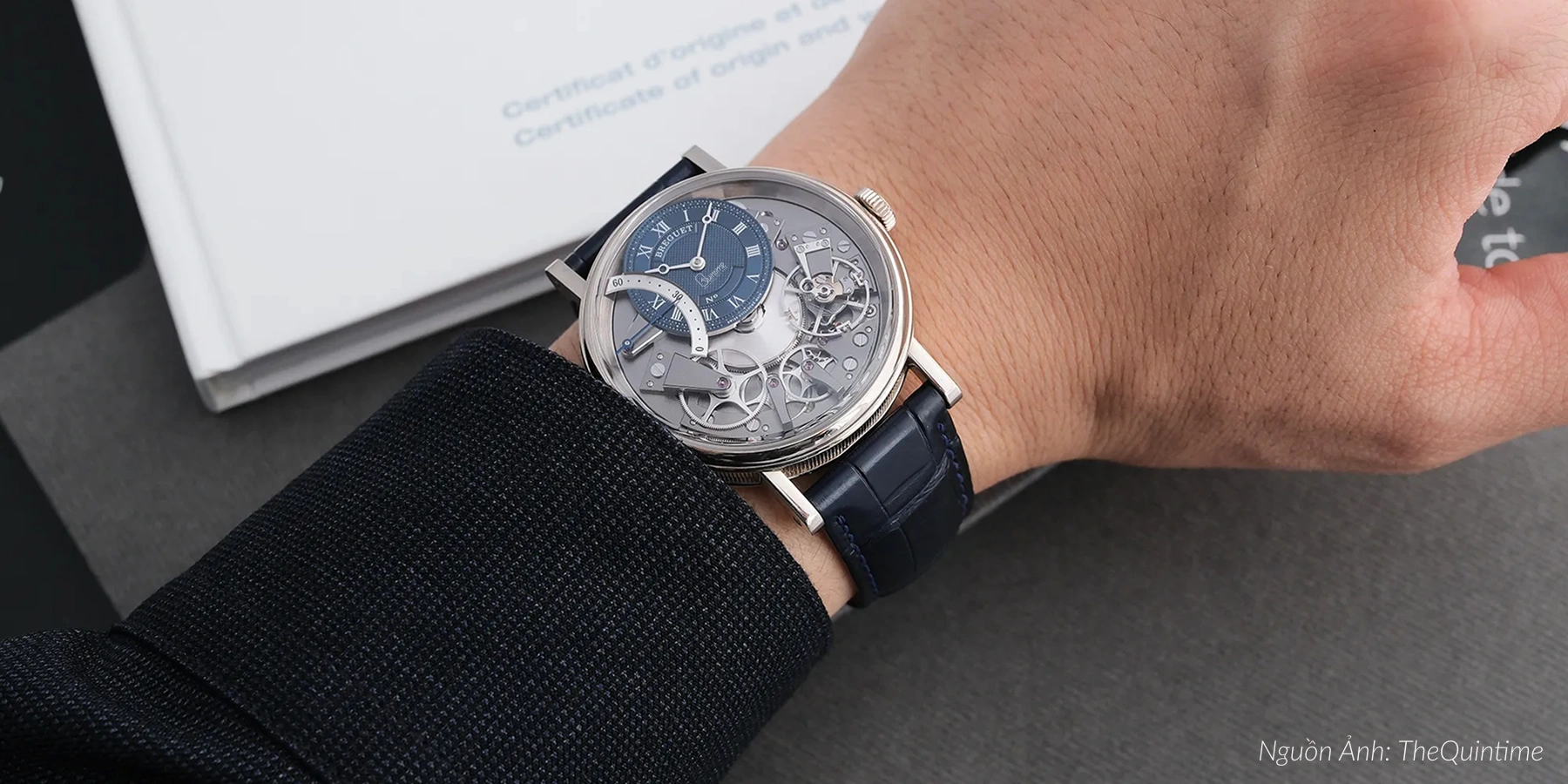
The 18k white gold case, with straight welded lugs secured by screws, measures 40mm in diameter and 11.8mm in thickness. As with all Breguet timepieces, it features the brand’s finely fluted caseband.
The elegant symmetry of the original subscription movement is faithfully recreated on the dial of the Tradition 7097. As in Breguet’s pocket watches, the mainspring barrel sits at the center, flanked by two fan-shaped structures: one extending toward the large balance wheel with Breguet’s “pare-chute” shock protection at 3 o’clock, and the other at 9 o’clock supporting the center wheel of the gear train.
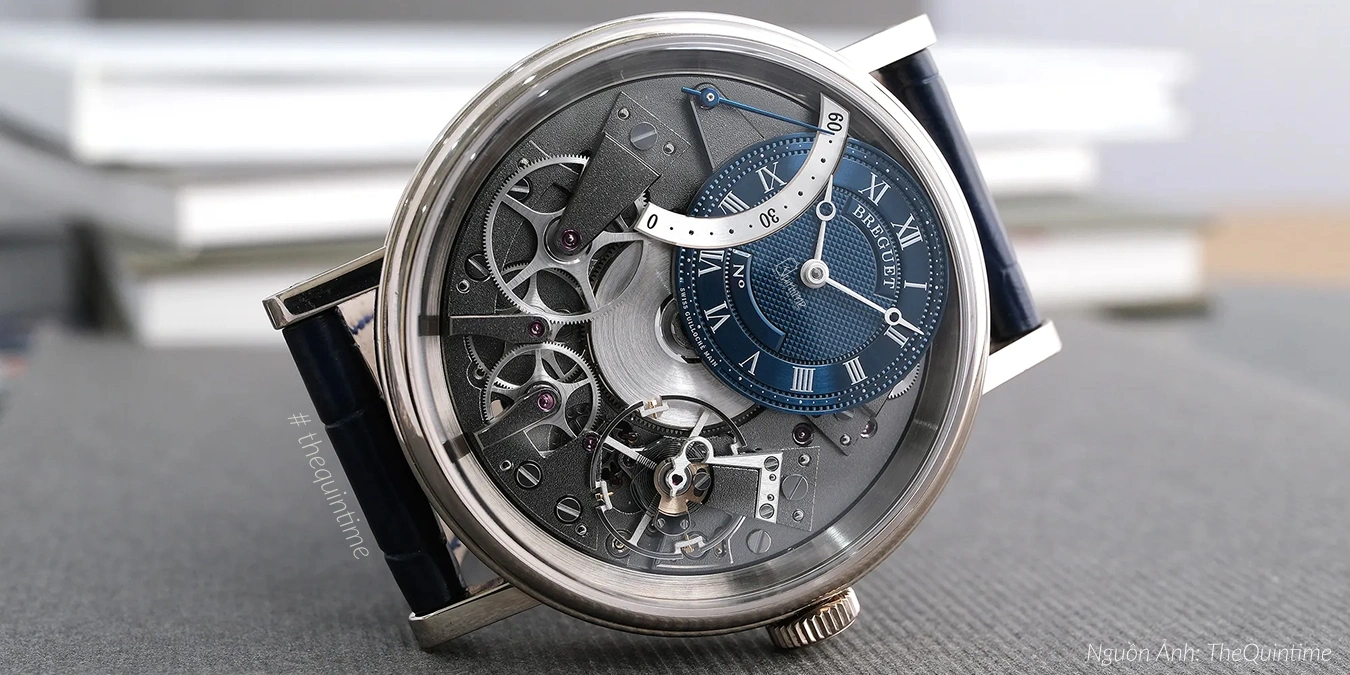
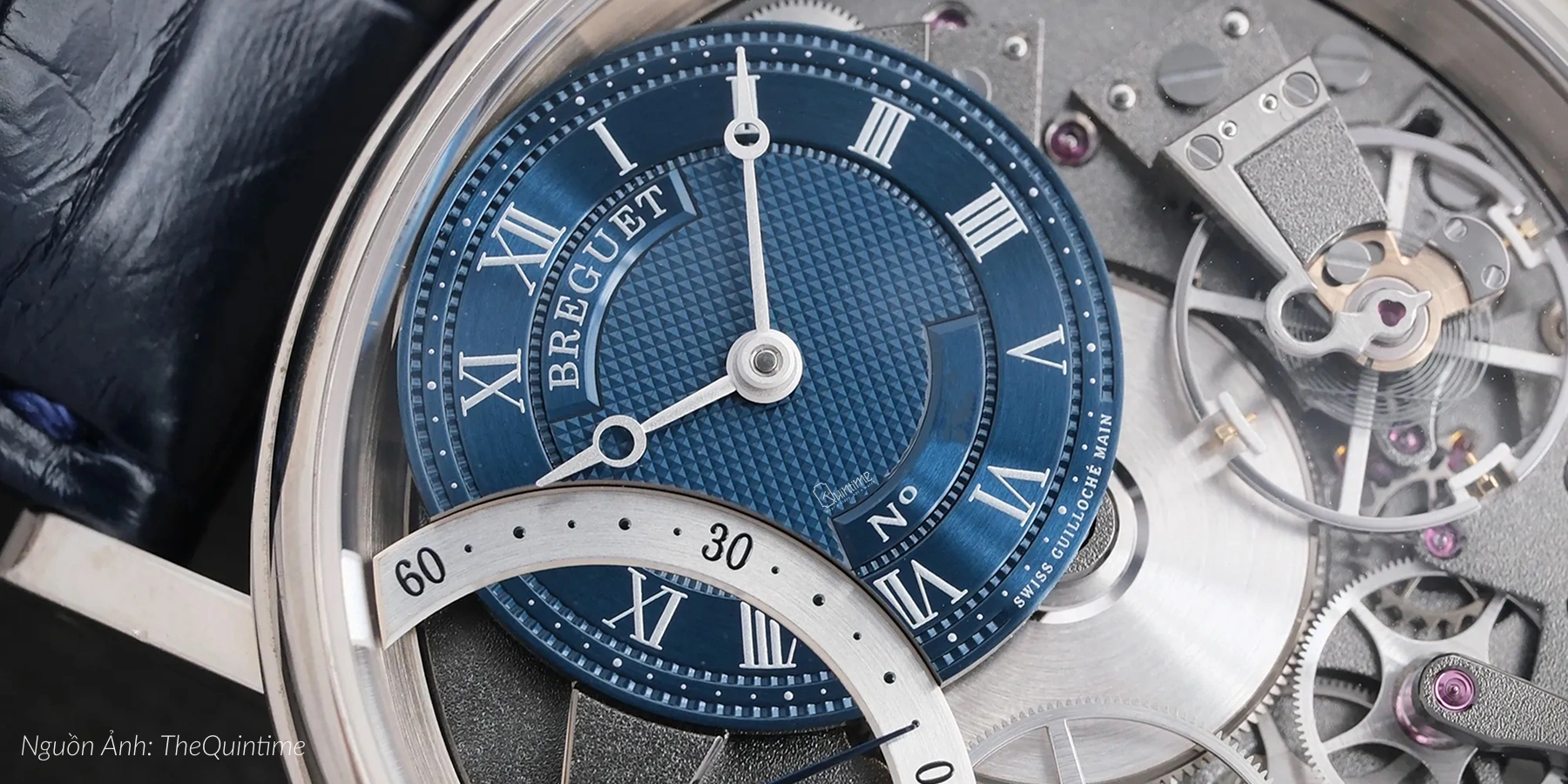
In contrast to the original’s simple single-hand enamel dial, the 7097 consolidates all time indications on the upper half of the dial. The off-centre hour and minute display at 12 o’clock is intersected by a gracefully curved arc for the rétrograde seconds. The gold dial, engine-turned with a hobnail guilloché pattern at its center, is now rendered in a new blue tone. Roman numerals and the signature open-tipped hands remain unmistakably Breguet. The rétrograde seconds track sweeps across the hour-minute display from roughly 7 to 10 o’clock, finished with circular graining, and indicated by a blued steel hand.
The dark grey baseplate and bridges feature an unusual surface treatment that can easily be mistaken for sandblasting. Unlike traditional finishes such as Côtes de Genève or perlage, this textured, almost industrial surface is achieved through a technique known as peening, typically used to harden metal. In simple terms, the metal is repeatedly struck to create countless tiny indentations across its surface.
A modern movement
While many historical mechanical elements are brought to the dial side, the caseback is no less captivating. The highlight is an impressive 22k gold rotor, shaped to resemble the platinum oscillating weight found in Breguet’s “perpétuelle tact” watches. Mirror-polished by hand, the rotor rotates on ceramic ball bearings to complete smooth 360-degree turns.
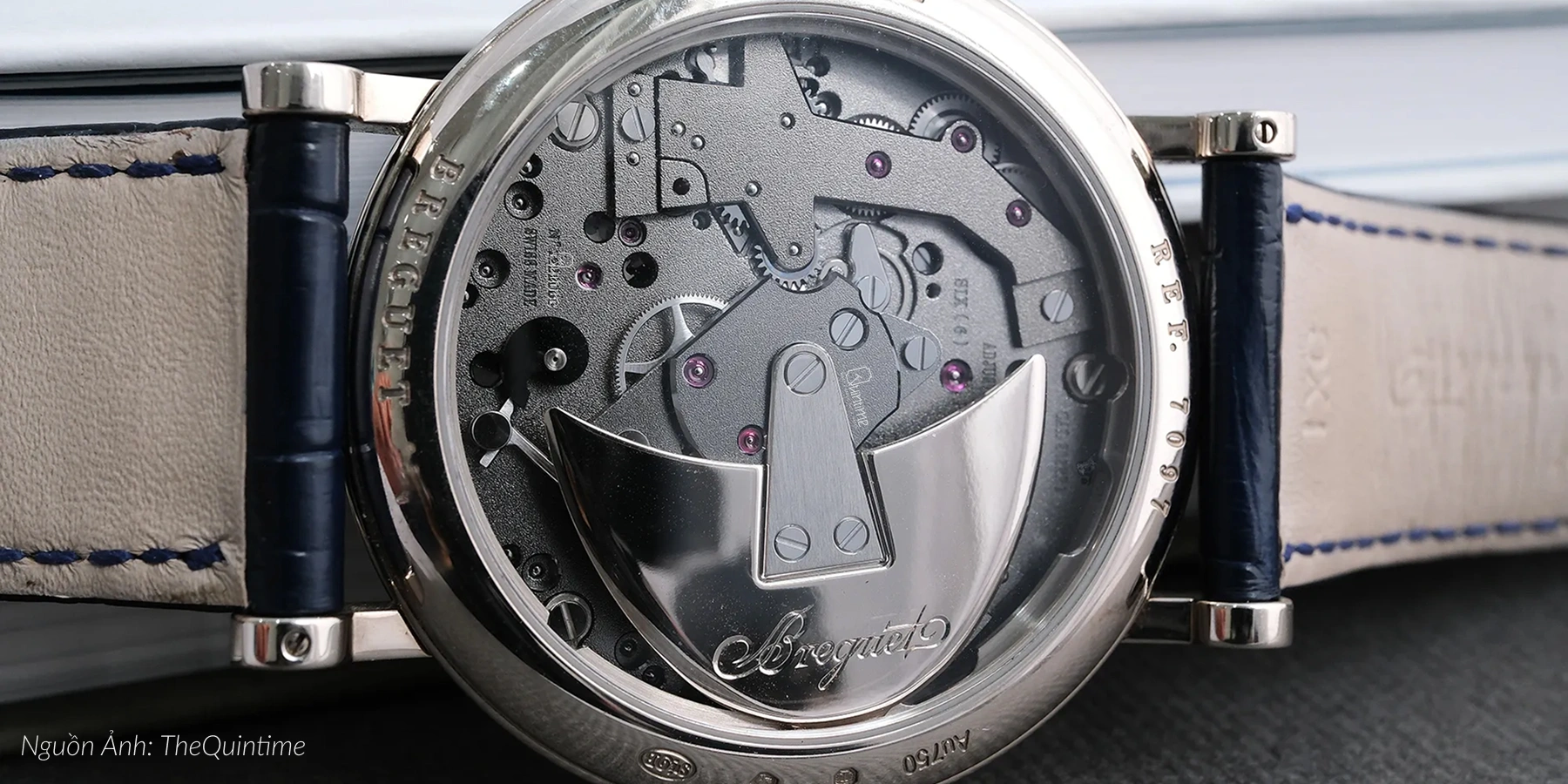
However, the historical references largely end there. The movement is equipped with an inverted in-line lever escapement featuring a silicon pallet fork, a silicon Breguet overcoil hairspring, 38 jewels, and a power reserve of 50 hours when fully wound. The balance wheel is made of rhodium-plated Glucydur, paired with a three-coil silicon Breguet overcoil hairspring.
Let’s take a closer look at the technical specifications of the Breguet Tradition Seconde Rétrograde 7097 Blue “Boutique Edition”.
Case: 40mm diameter, 11.8mm thickness – 18k white gold – fluted caseband – straight welded lugs with screw bars – sapphire crystals front and back – water resistance to 30m.
Dial: gold base – off-centre blue hour-minute dial at 12 o’clock with guilloché engraving – individually numbered and signed – Roman numerals – open-tipped Breguet hands – rétrograde seconds at 10 o’clock with a blued steel hand.
Movement: Breguet calibre 505SR1 – automatic – gold rotor – 50-hour power reserve – inverted lever escapement with silicon pallet fork – silicon Breguet overcoil hairspring – frequency of 3Hz – adjusted in six positions.
Strap: blue leather strap matching the dial.
Reference: 7097BB/GY/9WU
Conclusion & personal impressions
The Breguet Tradition Seconde Rétrograde 7097 Blue is not a watch that fits conventional notions of beauty. It does not try to please the crowd with classical symmetry or a clean, easy-to-read dial. Instead, it feels like a movement turned inside out, where every component is exposed, raw yet entirely intentional.
What makes it intriguing is this: amid all its technical complexity, Breguet manages to embed a distinct layer of emotion. The blue guilloché dial acts as a visual pause, allowing the wearer to “breathe” within a dense mechanical landscape. And the rétrograde seconds hand, with its sweeping motion followed by a sudden snap back, introduces a subtle jolt of drama.
The 7097, then, is not a watch for first impressions. It reveals itself on the second or third look, when you begin to understand why each gear is placed exactly where it is, why the surfaces are painstakingly peened rather than polished, and why Breguet chooses to tell its story in this way.
If one were to sum it up briefly, this is a Breguet that is deeply, unmistakably “Breguet”: respectful of its heritage, yet not confined by it. A machine where past and present do not merely coexist, but merge and move together, right on the wrist.


.webp&w=384&q=75)
