
[Part1 ] History of Germany watchmaker A.Lange & Sohne
Today, A. Lange & Söhne is widely recognized around the world—thanks not only to the brand’s outstanding marketing, but also to the writings of Reinhard Meis, along with the work of journalists and discerning collectors.
This article is a place for us to learn about and explore modern A. Lange & Söhne—an essential force that has helped shape contemporary watchmaking and the culture of German manufacturing. However, there is one era that far fewer people know about, and one that has not been appreciated as it deserves, even by the brand’s own admission: the period from 1845 to 1990.
To truly understand A. Lange & Söhne—and the watchmaking industry in Glashütte today—we have to look back to its roots. Only then can we fully feel the value of the mechanical works of art we wear on our wrists.
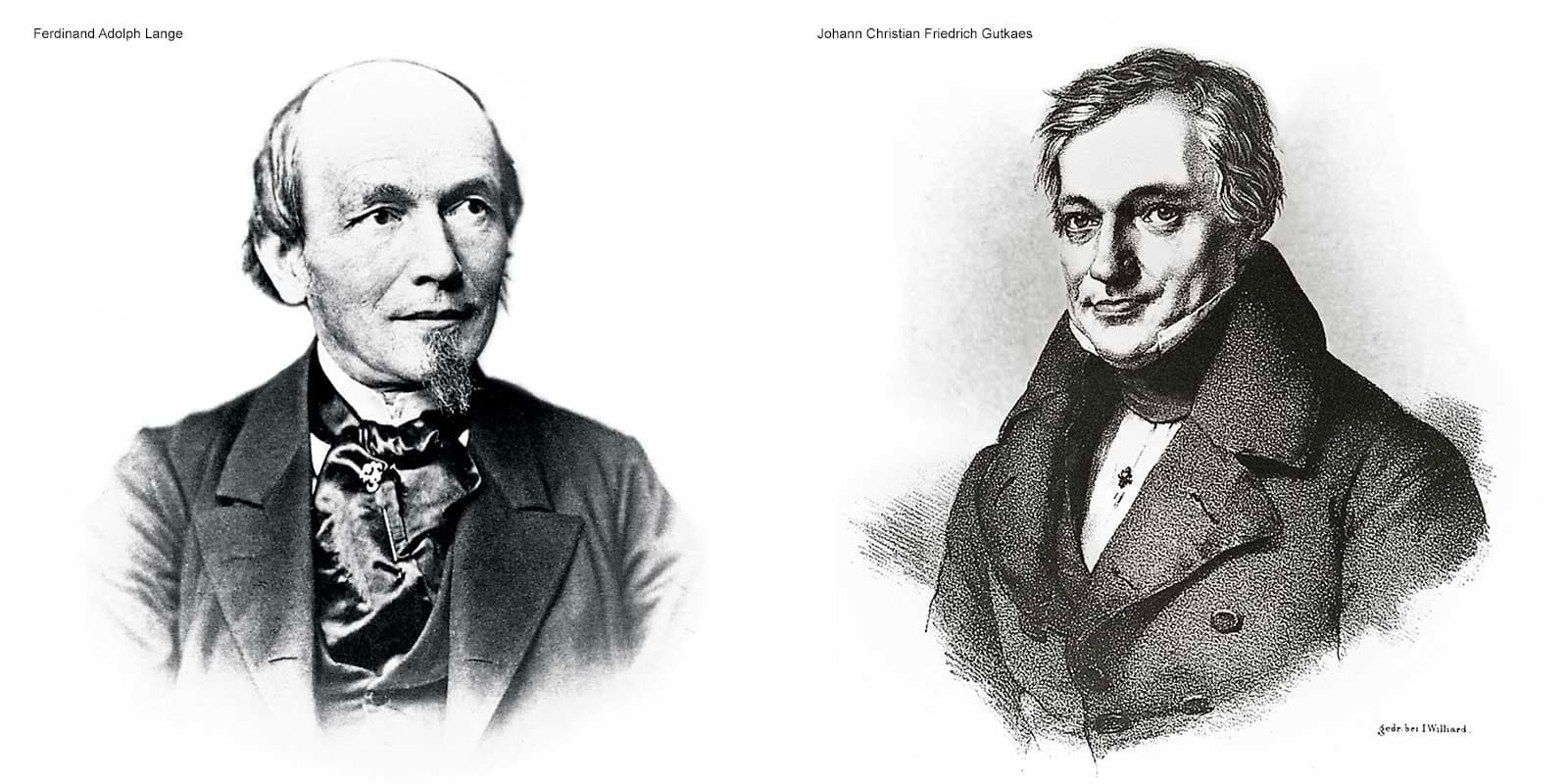
And we will begin with Ferdinand Adolph Lange, the founder of A. Lange & Söhne.
Ferdinand Adolph Lange was born in 1815, the son of Johann Samuel Lange.
When he was young, his parents separated, and he was adopted by another family. Fortunately for him—and fortunately for us—that family gave him the chance to receive a proper education.
In 1829, at just 14 years old, he was admitted to the Dresden University of Technology. The program was demanding: six days a week, divided into three days of theoretical study and three days of practical handcraft training under an instructor’s guidance. And his teacher was none other than Christian Friedrich Gutkaes—the maker of the famous five-minute clock at Dresden’s Semperoper, and later the court clockmaker for the royal palace.
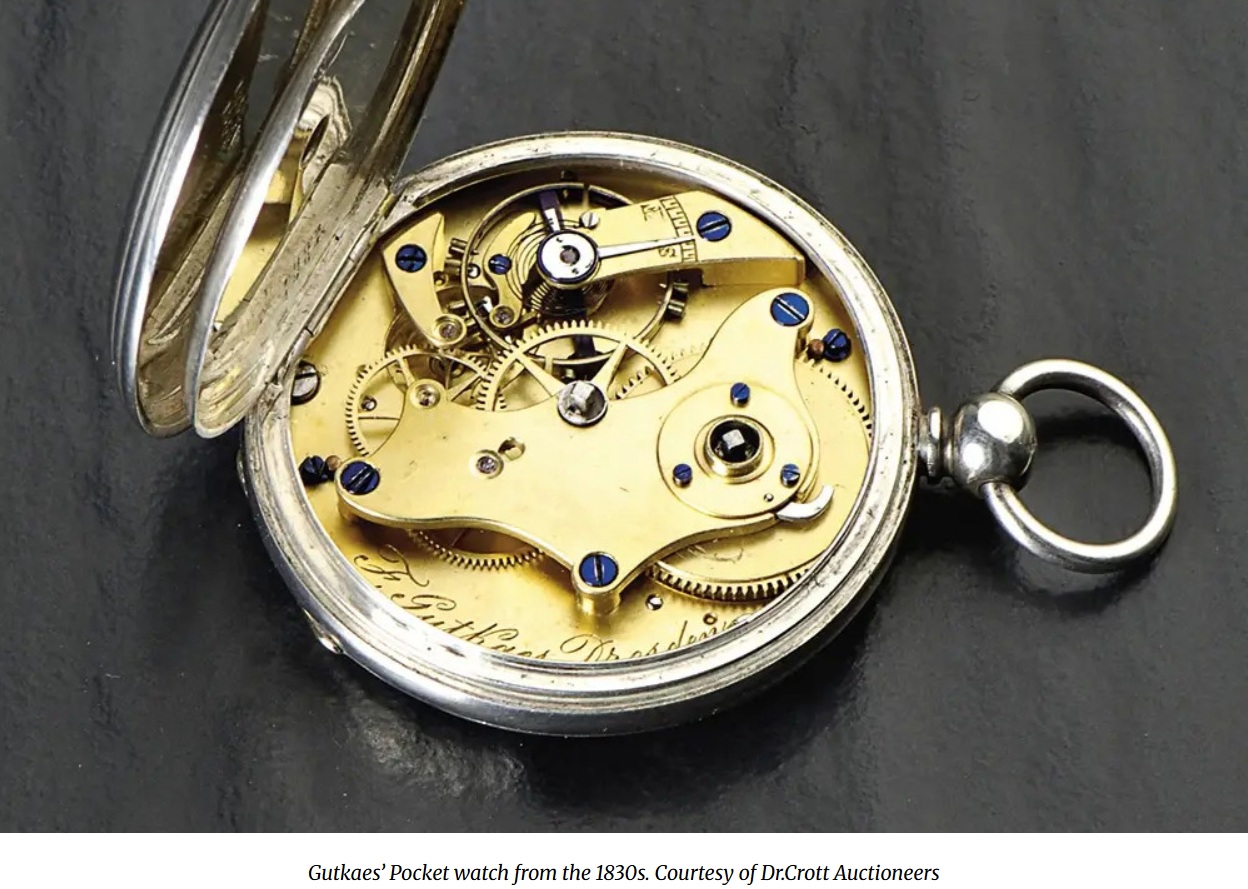
After six years of diligent study, he completed his apprenticeship with top honors and continued working with his teacher, Gutkaes, as an assistant for more than two years.
During his time studying and working alongside Gutkaes, Ferdinand Adolph Lange demonstrated exceptional craftsmanship, work ethic, and intelligence. Gutkaes grew very fond of him and approved of his relationship with his daughter, Antonia.
However, Lange’s ambition at the time was still to become a true master watchmaker. To achieve this, he decided to further refine himself and set out on a journey to learn from the very best in the world. By studying languages alongside watchmaking, he became fluent in French and went on to train in Paris, Switzerland, and England.
In 1837, he began working near Paris with the Austrian watchmaker Joseph Thaddeus Winnerl (1799–1886)—a former student of Abraham-Louis Breguet who ran one of France’s leading watch workshops. Ferdinand Adolph Lange served as workshop manager while also studying astronomy and physics at the Sorbonne in Paris. Most importantly, he continued to elevate his watchmaking skills under renowned teachers in the city.
Highly satisfied with Lange’s work, Winnerl offered him a longer stay, but Lange declined—partly because, in a letter written before his journey to France, Gutkaes had reminded him to return home.
Gutkaes wrote to him:
“Do not forget your homeland! It will welcome you back with open arms if you return one day. When you have gained experience and proven yourself worthy of the art of watchmaking, you will be able to develop it and enrich it greatly.”
In 1841, he returned to Dresden, where Gutkaes’ daughter Antonia was waiting for him. Ferdinand and Antonia married in 1842—the same year he received his master craftsman’s certificate. That year, his father-in-law was appointed Royal Clockmaker and was granted an apartment within the palace.
The sketches and travel notebook—filled with calculation tables, design drawings, mechanisms, and technical notes—show how curious and meticulous Ferdinand Adolph Lange was in his approach to horological problems. He produced watch components, especially gears, with specifications often calculated in Parisian units (one Paris line equals 2.2558 millimeters)—a reference still recognized today. He converted all measurements into the metric system—something that was still quite novel at the time.
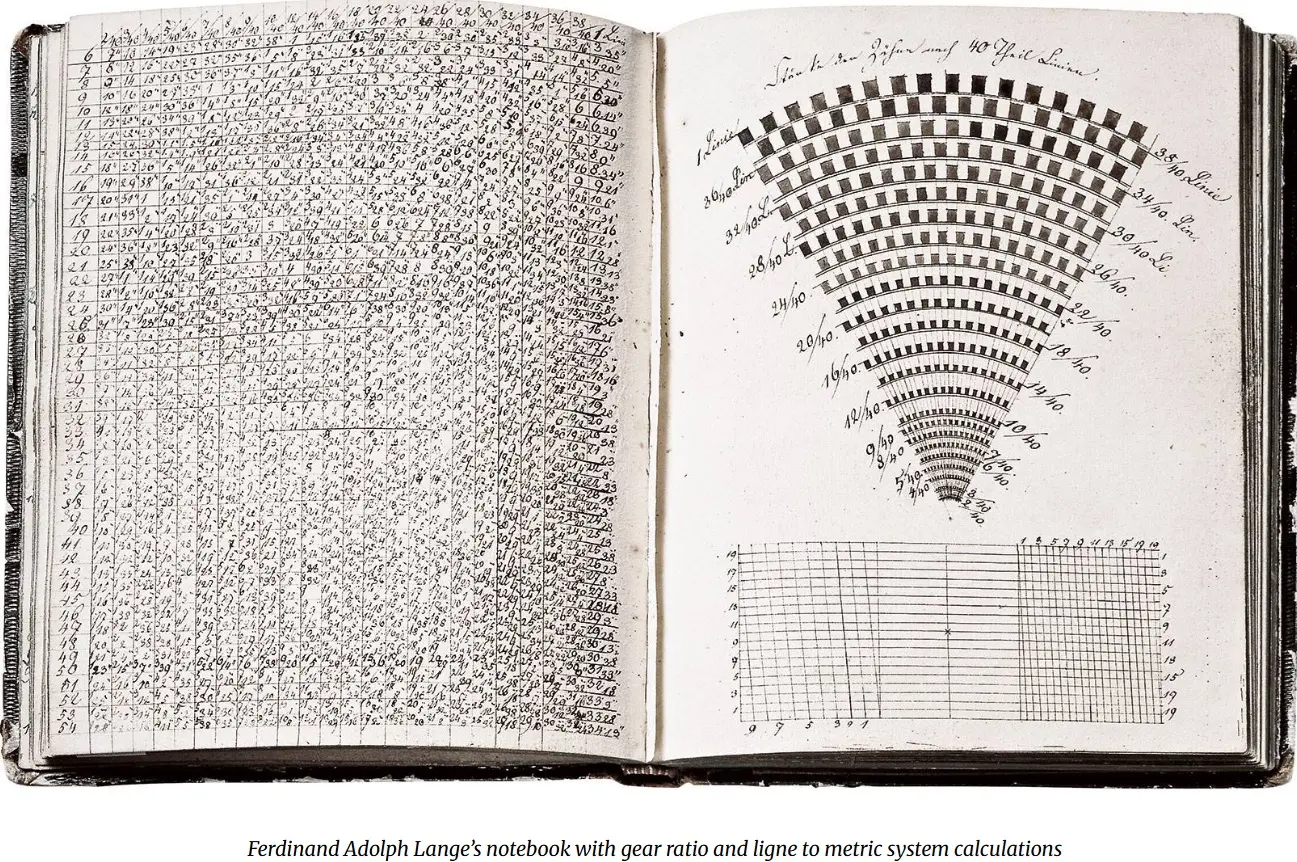
Therefore, it is hardly surprising that Ferdinand Adolph Lange achieved remarkable success in a short time as a partner in the company of his teacher—and father-in-law—Gutkaes, both as a watchmaker and as a businessman. His entrepreneurial ambition, along with his social conscience and sense of civic responsibility, continued to drive him forward.
He began launching a campaign built around an extraordinarily bold plan: to establish his own watchmaking manufactory in the Erzgebirge region, creating a distinctive center that could stand apart from the refined watch factories of England and Switzerland.
To accomplish such a task, he needed substantial financial backing. He therefore wrote to the senior council of Saxony, presenting a detailed business plan. One passage that reveals his intention is often quoted as follows:
“…If the senior council is able and willing to provide the means for establishing an institution for the benefit of 10 to 15 young men, and to entrust me with its leadership, I believe that in the near future, livelihood and prosperity will spread to many of these unfortunate people…”
After lengthy discussions with the council, on December 7, 1845, Ferdinand Adolph Lange founded A. Lange & Cie.
As promised, he began with 15 young men. His employees were required to work with him for at least five years, and afterwards, Lange encouraged his apprentices to establish their own specialized companies—much like the Swiss model.
He did not merely start a single factory; together with colleagues such as Julius Assmann, Adolf Schneider, and Moritz Grossmann, he helped create an entire watchmaking cluster in the region. Over time, each component of a watch would be produced by a dedicated specialist, made separately to the highest possible standard.


